
Summary - Original published in: Ekonomska demokracija, št. 4/2015 (str. 4 - 14) in 5/2015 (str. 6 - 15) ŠCID. Kranj.
Mato Gostiša, PhD
A handful of challenges for economic and legal theory
(Neo)classical economic theory of capitalism is a dead body
Thus far theoretically substantiated and justified by (by all accounts scientifically ‘irrefutable’) truths/axioms of classical and neoclassical economic theory, contemporary ‘wage labour’ capitalism, along with its ever-greater disastrous economic, social and environmental costs, no longer has any relevant scientific basis. In modern socio-economic reality its key postulates seem like mere scientific misconceptions or even – in well-chosen words of J K Galbraith – ‘innocent frauds’. Similarly, the complex system of different sophisticated mathematical formulas and models, which was derived from the theory by marginal economics with the ambition of masking it as an exact science of permanent value, appears as wholly impractical theoretical clutter. Most of all, it is becoming quite evident that the practice of “textbook capitalism” no longer exists. This is explicitly manifested in numerous present-day occurrences, such as the ‘managerial revolution’, the typically ‘socialist’ approaches of state-interventionist recovery of a messed up – predominantly private – banking system taken at the taxpayers’ expense during the last economic crisis, the ignorance of the existing and undeniably economically-active ‘human capital’ along with the rights of its owners by the legal system, and many others which have nothing to do with rudimentary principles of capitalism. (Neo)classical economic theory of capitalism is therefore, in truth, nothing more than a scientific corpse[1], and the resulting current socio-economic system is an utter and ever more unprincipled archaism, at odds with modern socio-economic reality and artificially kept alive as a result of a (likewise archaic) legal system driven by the coercive power of the state under the control of momentarily privileged economic elites.
And these elites will use their economic and political power until feasible to effectively block all attempt at a (otherwise indispensable) thorough reconstruction of today’s capitalism, even though it is clearer by the day that the latter is becoming conclusively obsolete. However, in the long run no one can stop further societal development. We therefore urgently and as soon as possible need a new social contract, based on fundamentally different economic and legal theory, which would set up a completely new, more economically efficient, socially just and environmentally responsible socio-economic system.
It is without a doubt that realistic alternatives to contemporary ‘wage labour’ capitalism do exist. Even ones which are fully market-oriented. A very promising concept in this respect is offered by the theory of economic democracy, economic democracy being a socio-economic system, which essentially still rests on private property and the market but is at the same time based on complete systemic equality of owners of both human and financial capital. A scheme as such would definitely signify a new systemic paradigm of capitalism; it would, however, require a thorough reconstruction of some key institutions intrinsic to capitalism of the day. For this reason social science will first have to conclusively dispense with the abovementioned deeply rooted theoretical misconceptions and ‘innocent frauds’, for the time being restricting a meaningful penetration of any serious alternative thought.[2]
The alarming developmental ‘lack of ideas’
The finding that a thorough reconstruction of contemporary (in essence, as noted, still typically wage-labour) capitalism is inevitable has been, until recently, a highly topical issue amongst scientists, especially in the first period after the outbreak of economic crisis in 2008. Nevertheless, lately it seems as though social science has again completely given up on this challenge. If we discard certain more or less utopian ideas about what should be reformed and how, the lack of ideas in this field is again almost complete and highly alarming. Every thought in most cases eventually ends up at mere cosmetic and systemically benign ‘structural reforms’, which do not even touch upon the foundations of contemporary capitalism, let alone change it.
This is not particularly surprising. The mainstream (neo)classical economic theory is at this point still very much caught in a web of ‘truths’, which it has long ago adopted as a sort of axioms, even dogmas, and which it does not depart from at any cost, regardless of the radical changes in objective socio-economic reality of the past decades. Even though we are talking about ‘truths’ that either never actually applied or are at least no longer valid in factual socio-economic circumstances of the 21st century (especially considering the fast growing production value of so-called intellectual, i.e. human and structural capital of companies, compared to their financial capital), the mainstream theory is reluctant to pursue a scientific reassessment. Surely because a collapse of any of the key axioms would most likely bring down the theory as a whole. Unfortunately, however, its unwillingness to reassess its premises is transforming it into a mere scholasticism and it is making it lose the character of a competent science that would be able to pave the way for further societal development.
For this reason it is certainly worth joining the existing minority of scientists, which have been warning us for quite some time now that, as per e.g. J P Damijan (2014: 9), economic theory has to redefine its present assumptions and be written anew, and that it would for the time being seem most appropriate to close the most prominent economic schools down for maintenance.
In the following paragraphs I will pursue – as best as possible considering the level of difficulty of the topic – to briefly analyse thirteen, in my opinion most controversial theses of (neo)classical economic scholasticism. As a final point, I will put forward a brief description of the concept of economic democracy as a potential new paradigm of capitalism, thus proposing a new ‘social contract’ on the foundations of our socio-economic system.
Key misconceptions/‘innocent frauds’ of (neo)classical economic scholasticism
(Note: In this shortened version of the paper the analysis of the first amongst thirteen theses will be the only one translated in full; the rest [2–13] will be summarised in the form of author’s key findings. Altogether the paper covers around 40 typed pages.)
Mistaken diagnosis as to the essence of existing capitalism
Thesis 1: The essence and two main foundations of capitalism as a socio-economic system are private ownership of the factors of production and market economy. This means that in both theory and practice the only alternative available is (either real or self-managing) socialism with state or public ownership and a planned or agreement-based economy. Unfortunately, socialism wasted its historical opportunity once and for all, and for this reason contemporary capitalism remains an absolutely superior economic system with no alternative or competition, regardless of its negative social implications. The latter simply have to be taken care of by welfare state intervention, whereas the foundations of capitalism are on the other hand not to be altered and can only be upgraded and improved.
Although this thesis is entirely inaccurate it nevertheless remains a notably effective ‘innocent fraud’, steering attention away from the true essence of contemporary capitalism and thus discouraging any meaningful alternative revision. In reality, private property has actually existed since the downfall of prehistoric communities. Similarly, as John K Galbraith establishes in his book ‘The Economics of Innocent Fraud: Truth For Our Time’ (2014: 16), the markets have played a significant role in economic history since the invention of forged money, attributed to the Lydians in the 8th century BC. Neither private property nor the market system are therefore not a capitalist innovation and as such cannot form its essence and foundation. Most of all, they are not at fault – except in the part of (quasi)labour market, which will be addressed separately below – for notably deviant economic, social and environmental impacts of contemporary capitalism and thus do not constitute its main difficulty. Property is namely far from being ‘a basic relation of production’ as was claimed by Marx, that being an illogical assertion[3] understandably[4] taken on board by neoclassical economists.
The essence of capitalism in general is the capitalist mode of production (being more advanced compared to slave-labour and feudal), and its only specific innovation is the labour market and arising therefrom the wage-labour or common exchange (sale and purchase) relationship between owners of labour and capital[5]. It is the latter, and not property, that is the actual ‘basic relation of production’ and also forms the core of all deviancy of contemporary capitalism considering its aforementioned catastrophic economic, social and environmental repercussions.
Still, the labour market is in fact a typical ‘quasi-market’. Together with the liberation of the workforce from feudal restraints in 18th and 19th century the latter was but a necessary prerequisite for establishing a more productive, i.e. capitalist mode of production. Then again, it naturally had to be such as to further enable – and even make more effective – the exploitation of labour by the owners of means of production. What changed was the form: feudal work was replaced by wage-labour. Otherwise the labour market never was and never will be a ‘proper’ market; it has always been a foreign object that was artificially forced into the market system due to abovementioned reasons. Why the ‘quasi-market’?
1. First of all, the labour market exchange is not even remotely free nor equivalent, even though both of these features are supposedly crucial preconditions for normal operation of any market according to mainstream economic theory. That is, if a worker is compelled to enter into such exchange for existential reasons, the ‘freedom’ of exchange is clearly nothing but a theoretical platitude. And if the wage of a (wage-labour) worker, being the result of such exchange, equals the ‘market price of labour force’ (i.e. merely corresponding to labour input) or the marginal product of labour reflecting its marginal utility for entrepreneur’s profit and not the actual ‘net product’ (output) of labour, we need not turn to Marx to decipher that the worker’s income does not equal their actual contribution to the product. In contrast to land, equity and creditors’ equity, labour is thus the only factor of production which fails to bring profit for input to its owners in the context of production and distribution. Hence, for what reason would the workers as rational beings choose to enter into such unequal exchange, if they were not systemically forced?
2. Secondly, neither production as the first stage nor distribution as the third stage of economic process are an ‘exchange’ (sale and purchase) by nature. The latter, namely, neither creates nor distributes anything. Production, on the other hand, is a process of creating new value (not merely exchange of existing value) by means of complete co-dependency (and not reciprocal exchange) between labour and capital where the extent of their respective contributions to end product is unknown and cannot in the least be made known by the market with its supply and demand mechanism. Therefore, if the product is to be distributed in the same manner as it was created, the task of regulating relations of production and distribution cannot be assigned to the market. Still, the ‘quasi-market’ of the day carries out this task.
3. Thirdly and finally, the claim that the labour market is supposedly ‘an indispensable feature of market economy’ is based on the following two, in essence, utterly misguided philosophical assumptions, i.e.:
- labour is a market good that can be sold independently of a person,
- capital without labour is sufficient for establishing a capitalist enterprise.
This is why it is outright inconceivable that nowadays even the law uncritically accepts and supports such constructs of economic theory. But we will return to this at a later time in connection with the detailed critical analysis as to the other contentious theses of (neo)classical economic theory.
In line with the essence and nature of production, capital and labour (human capital) thus simply cannot be in a relation of mutual exchange, neither in the stage of production nor in the stage of product distribution. In the context of normal economic logic this is clearly counterintuitive. The wage-labour relation between them is in reality a quasi-market or a quasi-exchange relation. The basic question as regards to this is certainly the following: according to what economic, legal or philosophical logic should one of the two factors of production of equal economic value in the production process (i.e. labour or human capital) simply sell itself to the other (financial capital) for a market price, when it is clear that one cannot carry out the production process without the other nor generate new value? Theoretically there is nothing of the sort that would warrant such a sale and purchase relation. Not in the least the (supposedly exclusive) risk and (supposedly self-evident) entrepreneurship of capital owners in production processes, which will be further elaborated on at a later point.
As the quasi-market functions and treats the wage-labour employment relationship as an integral feature of market economy, the (neo)classical economic theory directly negates its own remaining fundamental principles of market economy and thus contradicts itself. Nevertheless, in general market economy and capitalist mode of production could in fact function without anomaly and completely undisturbed even without this ‘quasi-market’, along an entirely different, essentially associative or cooperatively-conceived relation of production between owners of both fundamental factors of production. For this reason, the existing (wage-labour) capitalism in all its contemporary (both liberal and welfare state) variations is far from being the only paradigm of ‘capitalism without alternative’, let alone the most optimal one.
The contentious wage-labour employment relationship as the fundamental relation of production, determining and permanently generating an ever greater inequality, profit-orientation, permanent cyclical recessions, an economy with no consideration of social and environmental implications, and other deviant phenomena of existing capitalism, is not an undisputable ingredient of a market economy, but merely a result of the current ‘social contract’ regarding the relation between labour and capital. And as such, it can obviously be reformed at any time, i.e. without any harm to private property or the market system.
The precondition for any kind of thoughtful reform of existing capitalism is thus first and foremost a correct diagnosis of what causes its deviancy, which is well concealed by the above-contested thesis of neoclassical economic theory. To be precise, merely a correct diagnosis reveals that the core of this capitalism can only really be altered with abolition of the contentious wage-labour relation of production (and with it, the quasi-labour market as a regulator of relations of production and distribution between owners of labour and capital), whereas everything else amounts to nothing more than superficial corrections. What is more, a reform as such is not at all unthinkable; it would require only some of the fundamental systemic institutions to be transformed, i.e. the ones that determine and generate the abovementioned fundamental relation of production (without interference with private property and the market system in general). These are primarily the dominant conceptions of capital and the capitalist enterprise as the central pillar of our socio-economic system, which will be further elaborated on below. These are also precisely the ones that the neoclassical economic theory clings to with all possible vigour.
* * *
The following paragraphs introduce short summaries of author’s key findings as to the remaining theses, which are otherwise comprehensively analysed in the full-length article.
What exactly does ‘capital’ stand for today?
Thesis 2: Capital consist of (tangible and/or financially evaluated intangible) assets that are invested or otherwise engaged for the purposes of pursuing economic activity with the objective of generating economic income for its owners. The entirety of capital is documented in company accounts.
Summary of author’s key findings: With regard to this thesis the author briefly sums up the findings of modern ‘theory of intellectual (human and structural) capital’ and points to the paradox of existing socio-economic system by asking how is it possible that even nowadays the entire system of corporate governance and distribution of newly generated value still rests exclusively on ownership of financial capital, when it is clear that on average around 85 % of real market value of companies (and consequently their production power) comes from intellectual capital of their employees. We are therefore talking about a completely archaic socio-economic system that lost touch with objective socio-economic reality of the 21st century and ‘the era of knowledge society’. Due to its negative motivational influence on owners of intellectual capital as the main competitive advantage in modern economic circumstances it is not only systemic, but an overall economic anachronism.
Enterprise as the other word for legally personified (financial) capital
Thesis 3: Legally personified in the form of a corporation, financial capital constitutes the enterprise, and its owners are simultaneously the owners of the enterprise. However, in economic terms it is not essential to determine who owns the enterprise, who leases whom and why. The enterprise is simply a nexus of various contracts where all parties (shareholders, employees, buyers, suppliers etc.) come together due to lower transaction costs and the resulting shared benefits, and where capital can lease the workers as much as the workers can in fact lease capital.
Summary of author’s key findings: The assured financial capital is merely the so-called material base of the enterprise as a legal personality (corporation), which in and of itself (i.e. without involving labour as the so-called personal base) lacks the capacity to pursue business activity. This capital is thus only an ‘economic foetus’, which is unfoundedly accorded various types of corporate personality by the law, contrary to the law’s own theory of legal personality. In contrast to the concept of enterprise under consideration, the author develops an outline of the so-called partnership model of capitalist enterprise as an ‘equal legal union of human and financial capital (and their owners)’. Only a union as such meets the fundamental assumptions of legal theory as to the recognition of legal personality, while it is at the same time also the single logical solution since capital and labour are not equipped to produce anything when isolated from one another.
The 1970s Friedman delusion
Thesis 4: “The corporation is an instrument of the stockholders who own it”, which is why in market economy “there is one and only one social responsibility of business - to use its resources and engage in activities designed to increase its profits” (Friedman. 2011: 12–13).
Summary of author’s key findings: A legal entity has no ‘owners’; instead, the entity itself holds rights of ownership over its assets. Thus, even from a strict legal perspective the owners of capital do not actually ‘own’ the enterprise or have it at their disposal exclusively according to their self-interest. Corporations get all their business resources from their natural and social environment, which is why they are not only accountable to the owners of capital (as merely one of the stakeholders), but they are also required to serve and repay their entire environment. The classical ownership-based conception of enterprise and corporate governance is in consequence a wholly unacceptable construct. We urgently need to adopt a different theory on corporate social responsibility.
Factors of production as a market good and earnings as their market price
Thesis 5: In a market economy all factors of production are self-evidently and without exception a market good, while the earnings of their owners are their market price, which means that all factors of production are treated equally by the system and therefore no socio-economic system can be more just in economic terms.
Summary of author’s key findings: This claim is false. It is a grave scientific misconception or perhaps even a conscious deception. Nothing of the sort is accurate for equity or profit as the earnings of equity’s owners; on the contrary, as a factor of production and its revenue they are both a systemic ‘sui generis’ of the current socio-economic system. Investment of initial capital in the enterprise is no sale and purchase (who is supposed to be the buyer or the seller, what is supposed to be the market price?). Even further along, equity never actually performs as an independent market good. Only the enterprise, either as a whole or in shares, can be the subject of sale and purchase. But at that point the market value already takes account of the value of intellectual capital not owned by the capitalist. Profit (actual and/or expected) as a ‘reward for risk-taking and entrepreneurship’ of capital owners is not a market price of anything. For this reason alone the (neo)classical economic theory as a whole appears to be a completely inconsistent scientific construct; it is based on double standards in treatment of different factors of production and their earnings, which shatter its most elementary necessary theoretical consistency.
Labour – factor of production on paper alone
Thesis 6: The essence of so-called fundamental factors of production is in their ability to generate new value and thus bring economic gain to their owners for input of the latter in the production process.
Summary of author’s key findings: This is also untrue. It definitely does not apply to labour. Labour – in contrast to equity, creditors’ equity and land – is awarded for its participation in the production process by nothing more than the market price or the equivalent of its input. The wage of a worker is thus basically just an ‘amortisation of the workforce’ and not a proper economic gain for the input of this fundamental factor of production, as is otherwise the case with profits of equity owners, interest of creditors’ equity owners and rent of land owners. The ‘system’ of labour exploitation in wage-labour capitalism is therefore crystal clear even without studying Marx. At this point – and in connection with what was said thus far – it becomes seriously questionable whether the economic theory under investigation possesses any generally valid principle or rule whatsoever that would justify it as a comprehensive scientific ‘theory’ on solid grounds.
Can labour even be a market good?
Thesis 7: By indirectly (i.e. via the enterprise in place of an employer) buying labour on the market for a wage as its market equivalent, the owners of capital become owners of labour and therefore have it at their disposal as their property in the production process, while at the same time justifiably appropriating the entire surplus of labour’s output that is left after repayment of other participating factors of production (wages, rent, interest).
Summary of author’s key findings: Labour in principle cannot be a market good (“Labour is not a commodity.” – Article 1 of ILO Declaration of Philadelphia). If one sells labour, which is naturally inseparable from a person, one sells a person. No socio-economic system apart from slave-ownership therefore cannot be based on considering labour as a market good for sale at a market price, as is the case with wage-labour capitalism. Besides, modern-day labour of ‘the knowledge era’ has long ago lost the characteristics of a traditional ‘workforce’; on the contrary, it has already been accorded the status of (human) capital proper (knowledge and capabilities, creativity, work motivation and organisational commitment of employees) by contemporary economic theory. And so, it is high time for labour to be accorded this status systemically.
Entrepreneur as the sole product maker
Thesis 8: A product (new value) is made solely by the entrepreneur through entrepreneurship, in the framework of which he/she combines his/her equity and other factors of production or inputs bought, rented or hired on the market (labour, land, creditors’ equity) into an optimal production totality according to the principles of marginal productivity. Workers merely sell their labour force to the entrepreneur, which the latter then uses to carry out the production process as if it were his/her property and thus enjoying the same status as the remaining factors of production bought on the market. Workers have no merit with regard to the product and consequently enjoy no right to involvement in business results (profits or losses). They are to be grateful to the entrepreneur for even having their jobs and wages and, accordingly, means of subsistence.
Summary of author’s key findings: This is elementary (neo)classical understanding of entrepreneurship, which is closely related to understanding of labour as a market good and a regular factor of production considered under theses 6 and 7 (i.e. understanding of labour as that of a machine with predetermined production capacity or productivity that defines its market price). Similar applies to the conception of enterprise as legally personified capital and the 1970s Friedman delusion discussed above, and in fact the entire neoclassical theory of production and distribution that is based on the aforementioned ‘sui generis’ systemic status of equity and profit. The described understanding of enterprise and entrepreneurship, which artificially favours the significance of equity owners as some kind of ‘self-evident entrepreneurs’, unsurprisingly unveils a wide variety of noticeable gaps and discrepancies in (neo)classical economic theory. These are primarily the following:
- considering labour as an ‘unproductive’ factor of production,
- a wholly unreasoned theory of ‘distribution’, teaching that all 100 percent of the product is distributed through the market price of production factors, and at the same time turning a blind eye to profit for simply not knowing what to do with it in said distribution formula,
- the inability to theoretically define and systemically set up a ‘fourth’ fundamental factor of production (i.e. equity in close connection with ‘entrepreneurship’), as well as to justify profit as a ‘market’ return for its owners.
Capital owners as ‘self-evident entrepreneurs’
Thesis 9: Capital owners are (automatically) the sole bearers of entrepreneurship – from a business idea and constitutive initiative to leadership and management of companies along with undertaking the entirety of business risk –, while profit is an economically just reward for said entrepreneurship and therefore belongs exclusively to capital owners.
Summary of author’s key findings: This thesis comes from a time when as a rule capital owners were in fact bearers of all business functions (entrepreneurs in the strict sense of the word). Nowadays, however, when the bulk of economy consists of large corporations with capital owners as natural persons involved merely as ‘portfolio investors’ without any real influence on corporate management, the theoretical defence of the thesis in question rests exclusively on ‘business risk’ as the only remaining business function left to capital owners. The so-called agency theory, which has been reinvented after the managerial revolution and which a priori denies the existence and urgency of internal employee entrepreneurship whilst claiming that managers, who took over the majority of original business functions, are merely ‘agents’ of capital owners, is certainly both a legal and a factual absurdity. Managers are not agents of capital owners, with whom they share no direct legal ties, not even those of representation; in contrast, they are agents of companies, which are legally their principals. Here we witness yet another abuse of established legal institutions for the purposes of justifying economic inconsistencies of existing capitalism.
Business risk as a basis for profit appropriation
Thesis 10: Business risk is in any event inherent to capital owners alone, and not also to the workers, who do not risk anything by being involved in the company, let alone potential losses. For this reason the capital owners are alone entitled to the entire generated net profit.
Summary of author’s key findings: It is unclear why financial risk is supposed to be the only relevant form of business risk in our socio-economic system. Many other forms exist. And there is no risk more difficult than the existential risk, inherent predominantly to the employees. What is more, theory offers a variety of other legitimate arguments against the thesis in question (e.g. the possibility of capital owners to disperse their business risk, which is not available to the employees). In modern practice, especially in times of economic crisis with complex financial implications for the employees or when it comes to bankruptcies, the thesis fails to hold true even in strict financial terms. In consequence, it cannot be considered as a particularly convincing theoretical justification for the exclusive right of capital owners to corporate management and appropriating the entire net profit, at least not any longer. It is worth noting here that philosophically speaking there is no viable justification for automatic appropriation of results of someone else’s factor of production as opposed to one’s own; regardless, this is exactly what is happening in wage-labour capitalism between capital owners and labour owners. No such automatism can be justified on any ground; however, it is on the other hand possible and necessary to assess all the different bases for income in one way or another.
Product distribution is in no way ‘a marginal question’
Thesis 11: In a market economy the product is already distributed by the time it is produced, which is why theoretical consideration of the system of product distribution as one of the four stages of economic process (production, exchange, distribution, consumption) is of rather marginal importance. The vital question for economy and politics to engage with is how to produce as much as possible, and not how to distribute the results, as regarding the latter there is no arbiter more just than the market.
Summary of author’s key findings: The fact of the matter is that in this day and age (neo)classical economic theory actually lacks any kind of distribution theory, which naturally makes it gravely incapacitated as a whole. The so-called Clark’s theory of product distribution among various factors of production according to the marginal productivity principle essentially offers mere explanations and not a proper theoretical justification for the typically exchange-like character of the ‘market distribution’ model, which is not in fact distribution, but rather an exchange, i.e. plain ‘remuneration’ of the use of production factors according to the market price. However, it is precisely the issue of economically just product distribution that is nowadays proving to be the key economic issue for various reasons:
1. A critical share of contemporary academic economic science has been discovering for some time now that the present economic crisis no longer primarily concerns the crisis of inefficiency on the part of supply (production), as the latter is, according to J P Damijan (2014: 9), downright hyper-efficient in a globalised version of capitalism; on the contrary, it is essentially a crisis on the part of demand, which is consequential to inappropriate distribution of economic earnings and a growing social inequality. The cyclical crises of present capitalism, which cannot be a normal ingredient of a viable socio-economic system even according to general systems theory, are thus nothing more than common ‘crises of hyper-production’.
2. The issue of economically just product distribution is gaining in importance also in relation to the trend of accelerating technological development and, accordingly, the ‘robotisation’ of production, which in consequence requires fewer workers. But then again, work does not only provide material means of subsistence; it is also a fundamental condition for human self-realisation and thus a source of happiness and contentment. Nevertheless, if profit for capital owners continues to be the sole objective of enterprise, humanity will not be able to endure in any event due to the ruthless destruction of natural environment, which appears to be never-ending in this socio-economic system.
3. It is utterly illusionary to hope that, to paraphrase C Handy (2007: 8), modern knowledgeable workers will continue to go to work inspired and motivated merely by the thought that their societal mission is fulfilled as long as they eagerly generate ‘profit for somebody else’. A socio-economic system which clearly neglects ‘economic motivation’ of its most important factor of production, i.e. human capital, definitely lacks a long-term perspective.
So, how do we motivate ‘the most imperative capital’?
Thesis 12: Human is ‘homo oeconomicus’, which is why he/she can be most effectively motivated by pay raises and other material rewards. Generally and in addition to providing a suitable wage, it is however possible to achieve the optimal workforce efficiency through proven Taylorist measures, i.e. by analytical work segmentation, temporal optimisation of work processes, standardisation and measuring the effects of individual’s work in the work process, all in relation to a refined hierarchical system of command, strict control and sanctioning.
Summary of author’s key findings: This thesis served as a basis for classical Taylorist approach to designing and implementing measures for utilisation of available workforce, which has not only been completely exhausted in the ‘knowledge era’, but also started to show distinct counterproductive effects. Even traditional motivational theories (Maslow, Herzberg, Vroom etc.) already indisputably confirmed that in production processes human is no homo oeconomicus, who would work merely in order to receive a wage, but rather a creative and social being, who realises through work not only his/her material needs but also his/her personal and societal needs (as to rationalisation of own work and self-realisation, having an influence on conditions of that work, equal treatment, respect and acknowledgement, as well as security, good working relations and commitment etc.). Virtually none of these personal and societal needs of ‘modern knowledgeable workers’ can actually be met in conditions of present-day classical wage-labour position of the workforce. They can only be met in conditions of a highly developed system of modern employee participation and organisational involvement, manifested mainly through the possibility of: 1) a relevant, not merely marginal participation in business decision-making; 2) mandatory, not merely voluntary participation in company business results; and 3) potentially also a wider framework of internal employee ownership. The attempt to build long-term high competitiveness of enterprise without such versatile organisational involvement of employees is almost certainly bound to fail in contemporary economic conditions. In this context it is not enough to invest in new skills and knowledge (the human potential); the main question is how this potential can actually be discharged or engaged in production processes – through ensuring the highest possible degree of ‘employee engagement’ (i.e. work motivation and organisational commitment) – and thus transformed into ‘capital’ in the true meaning of the word. According to the findings of the renowned Gallup study on employee engagement there is still plenty of room in this area, while the available potential is far from realised.
Obsession with ‘capital friendly business environment’
Thesis 13: Without fresh capital or without perpetual capital deepening and expansion there will be no higher productivity, new enterprise, jobs or economic progress. This is why the central task of effective economic policy is creating a ‘capital friendly business environment’ (primarily by cost relief for employers), which will attract fresh capital investment, while other principal factors of production (i.e. land or natural resources and labour) remain available to a sufficient degree.
Summary of author’s key findings: In practice, a direct result of this economic philosophy is, on one hand, thoughtless exploitation of natural resources and careless attitude towards natural environment, the disastrous consequences of which are nowadays downright frightening. On the other hand, we are faced with continuous pressures of the economy on economic policy with regard to lowering labour costs (the infamous ‘labour market reforms’) and additional ‘tax relief of the employers’, predominantly relating to the burden of labour and costs of welfare. This philosophy is still the cornerstone of current economic policy in most of capitalist economies, which continue to bet everything on financial capital in the context of development, while wholly neglecting an ever greater (and in fact predominant) production significance of human capital and the vast uncharted room in this area. However, if this were the only issue, it would not be so bad. Unfortunately, the fundamental problem hides in the fact that the aforementioned measures for creating ‘a capital friendly business environment’ are far from neutral when seen from the perspective of development and production engagement of human capital; on the contrary, they virtually signify the killing of (even existing) human capital. In connection with what was said thus far, this economic logic appears utterly incomprehensible.
A new ‘social contract’: economic democracy
Summing up the findings of the present analysis, it is possible to discern clear outlines of the necessary changes to the ‘fundamentals’ of existing socio-economic system as well as a rough design of a new, more perspective one. Key alterations should be directed at gradual surpassing and, finally, abolition of the classical wage-labour relation between owners of labour and capital. In general, this is the entire science behind the much needed ‘reconstruction of existing capitalism’.
Having learned that the crucial issue of existing capitalism lies not in private property nor the market system in general, but in the wage-labour (i.e. plain sale and purchase or market exchange) relationship between labour and capital as two otherwise economically equal factors of production, it becomes evident that a thorough reform should only target the systemic institutions which actually directly determine and (with the help of the law) maintain this relationship. These are the existing institutions of capital, capitalist enterprise, (quasi)labour market, ‘capital-exclusive’ corporate management and distribution of newly-generated value. The required systemic changes are therefore the following:
- a substantial expansion of the institution of capital, with institutional inclusion and equal systemic treatment of intellectual (human and structural) capital;
- enforcement of a new, i.e. partnership conception of enterprise as an equal union of financial and human capital as well as their owners, through inclusion of human capital in company accounts, which would naturally require prior improvement of the so-called human resources accounting, and consequently also
- enforcement of the so-called associative conception of the employment relationship and with it the abolition of ‘quasi-labour market’ as a direct regulator of relations of production and distribution, and finally
- enforcement of a wholly equal corporate co-management of both categories of capital owners and their joint participation in business results corresponding to their actual contributions to the product, i.e. a type of ‘comprehensive co-enterprise’.
Naturally, none of this is mere utopia; these are long-term realistically implementable and in objective socioeconomic circumstances of the 21st Century also more or less self-evident changes with the objective of achieving full legally-economic equalisation of position and rights belonging to owners of financial as well as human capital in companies or, in other words, the establishment of economic democracy as a wholly innovative paradigm of capitalism. And even such that has nothing to do with Marxism, but rather exemplifies a strict ‘market’ alternative to the existing wage-labour capitalism. That is to say, it does not – apart from the segment of quasi-labour market – encroach on either the market economy or private property of capital, but rather adds to the socioeconomic system or, in other words, systemically institutionalises and places on equal footing a new, in modern economic conditions undoubtedly existing and economically-acting form of capital, i.e. intellectual (human and structural) capital. This is actually the entire, yet systemically crucial, novelty of the idea. And it seems unnecessary to explicitly point out what justifiable, automatic positive economic, social and community-building effects should be expected of it.
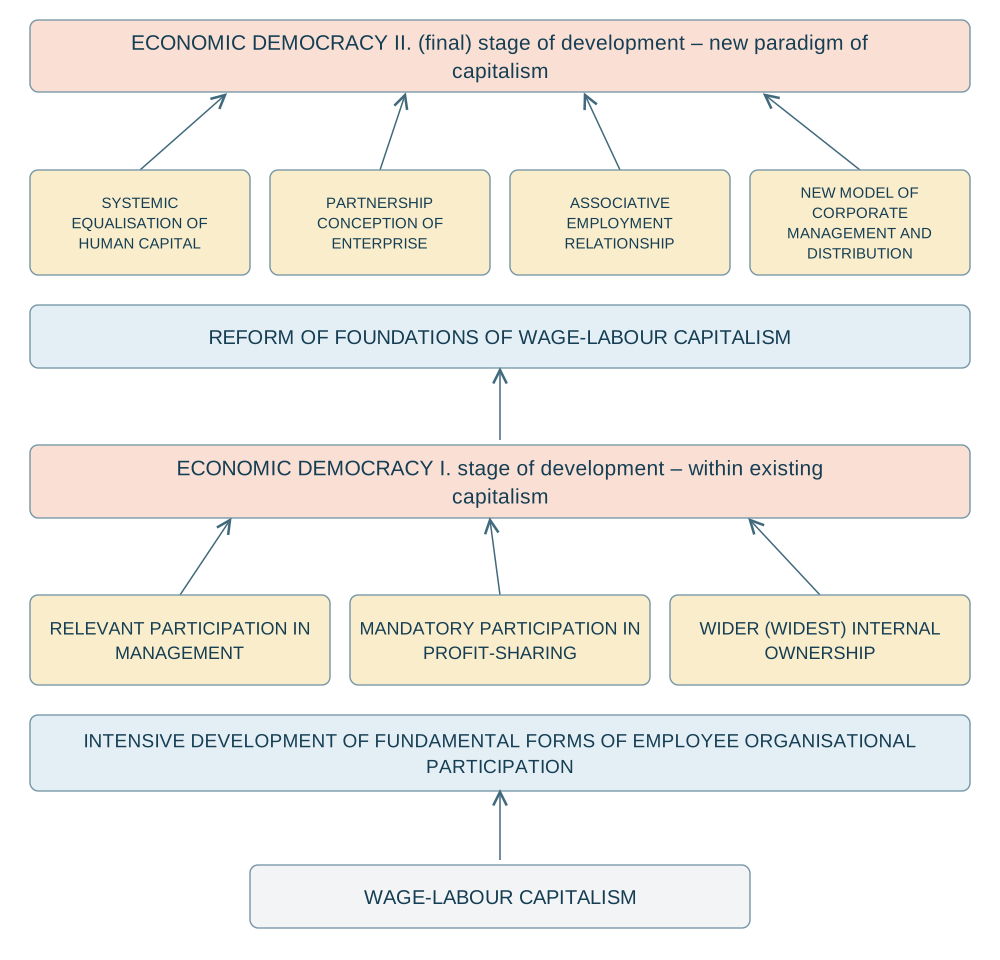
As systemic changes as such are naturally not achievable instantaneously, it is, however, of utmost significance that we begin to advance the rudiments of economic democracy as intensively as possible already within the framework of existing capitalism; namely, through developing different forms of modern (managerial and financial) employee participation, such as
- relevant, not merely marginal, workers’ participation in corporate management,
- mandatory, nor merely voluntary, workers’ participation in profit-sharing and
- wider, not merely managerial, internal employee ownership or employee shareholding,
which has already proved to bring about important positive effect on business performance according to scientific research. And that is exactly because it signifies a gradual and at least partial surpassing of the classical ‘wage-labour position of the workforce’, which has a massive effect on motivation of ‘human capital’. It does not appear at all reasonable to further postpone the first stage of economic democracy development (Image 6), because it offers – possibly already at the moment, but certainly in the long run – the only realistic path towards achieving higher productivity and creating higher added value in modern economic conditions at the global market. And this path is completely ‘free of charge’ and does not require any material sacrifices on the part of anyone. On the other hand, a perpetual and wholly futile aspiration to create a somewhat ‘friendly business environment for (financial) capital’ undoubtedly leads nowhere.
Image 6: Development of a system of economic democracy as the new paradigm of capitalism up to the second (final) stage[6]
Besedilo prikaza
ECONOMIC DEMOCRACYII. (final) stage of development – new paradigm of capitalism
SYSTEMIC EQUALISATION OF HUMAN CAPITAL
PARTNERSHIP CONCEPTION OF ENTERPRISEASSOCIATIVE EMPLOYMENT RELATIONSHIPNEW MODEL OF CORPORATE MANAGEMENT AND DISTRIBUTION
REFORM OF FOUNDATIONS OF WAGE-LABOUR CAPITALISM
ECONOMIC DEMOCRACYI. stage of development – within existing capitalism
WIDER (WIDEST) INTERNAL OWNERSHIPMANDATORY PARTICIPATION IN PROFIT-SHARINGRELEVANT PARTICIPATION IN MANAGEMENT
INTENSIVE DEVELOPMENT OF FUNDAMENTAL FORMS OF EMPLOYEE ORGANISATIONAL PARTICIPATION
WAGE-LABOUR CAPITALISM
Bibliography:
- Damijan, Jože P. (2014) Kaj se dogaja z ekonomijo? Delo, Sobotna priloga from 19. 4. 2014. ČZP Delo. Ljubljana.
- Friedman, Milton (2011) Capitalism and Freedom, Soleco d.o.o., Ljubljana (First edition: The University of Chicago, 1962, 1982, 2002).
- Galbraith, John Kenneth (2010) The Economics of Innocent Freud. Truth for Our Time. Družba Piano d.o.o. and Mladina d.d., Ljubljana. First edition: New York, 2004.
- Gostiša, Mato (2014) Ekonomska demokracija kot nova sistemska paradigma kapitalizma, ŠCID, Kranj.
- Grgič, Jožica (2014) Čigav bo svet čez 50 let? Delo, Sobotna priloga from 7. 6. 2014, p. 32. ČZP Delo. Ljubljana.
- Gruban, Brane (2011) Motivacija generacije 3.0: Zakaj korenček in palica ne učinkujeta? Lecture at Managers Congress 2011 in Portorož, 29-30 September 2011 (slideshow). Last accessed 13. 7. 2015 at: http://www.slideshare.net/Zdruzenje_Manager/brane-gruban-motivacija-30-zakaj-palica-in-korenek-ne-uinkujeta.
- Oberstar, Ciril (2013) Renesansa branja Marxa. Delo from 25. 2. 2013, ČZP Delo. Ljubljana.
- Samuelson, Paul A. in Nordhaus, William D. (2002) Economics, Sisteenth Edition, Naklada Mate, GV Založba, Ljubljana (First edition: The McGraw-Hill Companies, inc., 1998).
- Smith, Adam (2010) An Inquiry into the Nature and Causes of the Wealth of Nations), Studia humanitatis, Ljubljana (First edition: 1776).
- Pahor, Marko (2011) Človeški kapital - ključen dejavnik uspešnosti, Ekonomska demokracija, Nr. 3, ŠCID, Kranj.
“As we all know, contemporary economic science is a dead body and needs a pathologist more than it needs a physician.” (Oberstar, 2013: 9) ↑
This essay is based on summaries of author’s book, Economic democracy as a new systemic paradigm of capitalism, ŠCID, Kranj, 2014; it is, however, also substantively supplemented by some new findings. ↑
Property (title) is not a relation of production between owners of different factors of production (capital and labour) but a proprietary relationship between individuals as to a thing, i.e. an estate, which is something completely different and can be organised in a variety of ways in keeping with respect and protection of private property. The fact that nowadays this relationship is formulated as a ‘wage-labour’ (sale and purchase) relationship between owners of labour and capital is not a somewhat self-evident consequence of private property as to means of production itself, but rather a matter of contemporary ‘social contract’. Under a different social contract (i.e. a legal regulation of the socio-economic system in force) the same relationship could, for example, be formulated as an associative (mutually co-dependent and equal) relation of production, the case of which will be explored further below. ↑
The assertion actually works in favour of the previously criticised claim on the ‘end of history’ of socio-economic development pertaining to human civilisation, as well as of the more contentious claim that the market system by nature cannot be socially just, as economic and social justice are not synonyms and the function of economy is not to worry about social justice in a society. ↑
The theory actually strictly refers to ‘leasing’ and not sale and purchase of labour force, which only points to an attempt to cover up the essence of the wage-labour relation of production as the former sounds somewhat better. The fact is that in the production process the labour force is spent, whereas one can only lease things that can be returned to the owner after use. However, in reality the economic content of the relationship in question is the same in both cases – it is a plain market-exchange relationship, where the worker remains in a permanently dependent position enabling the employer to ‘legally’ appropriate a share of results of their labour. This is obviously unacceptable, as the worker has a right to the entire result of their labour. ↑
Source: M Gostiša, Ekonomska demokracija kot nova sistemska paradigma kapitalizma (2014: 130) ↑